The team runs the work
Plan, coordinate, publish, reply and report.
Investment Committee
 HeyMark
Investment Committee
HeyMark
Investment Committee
Social media management that actually knows your brand.
Investment Committee, July 2026
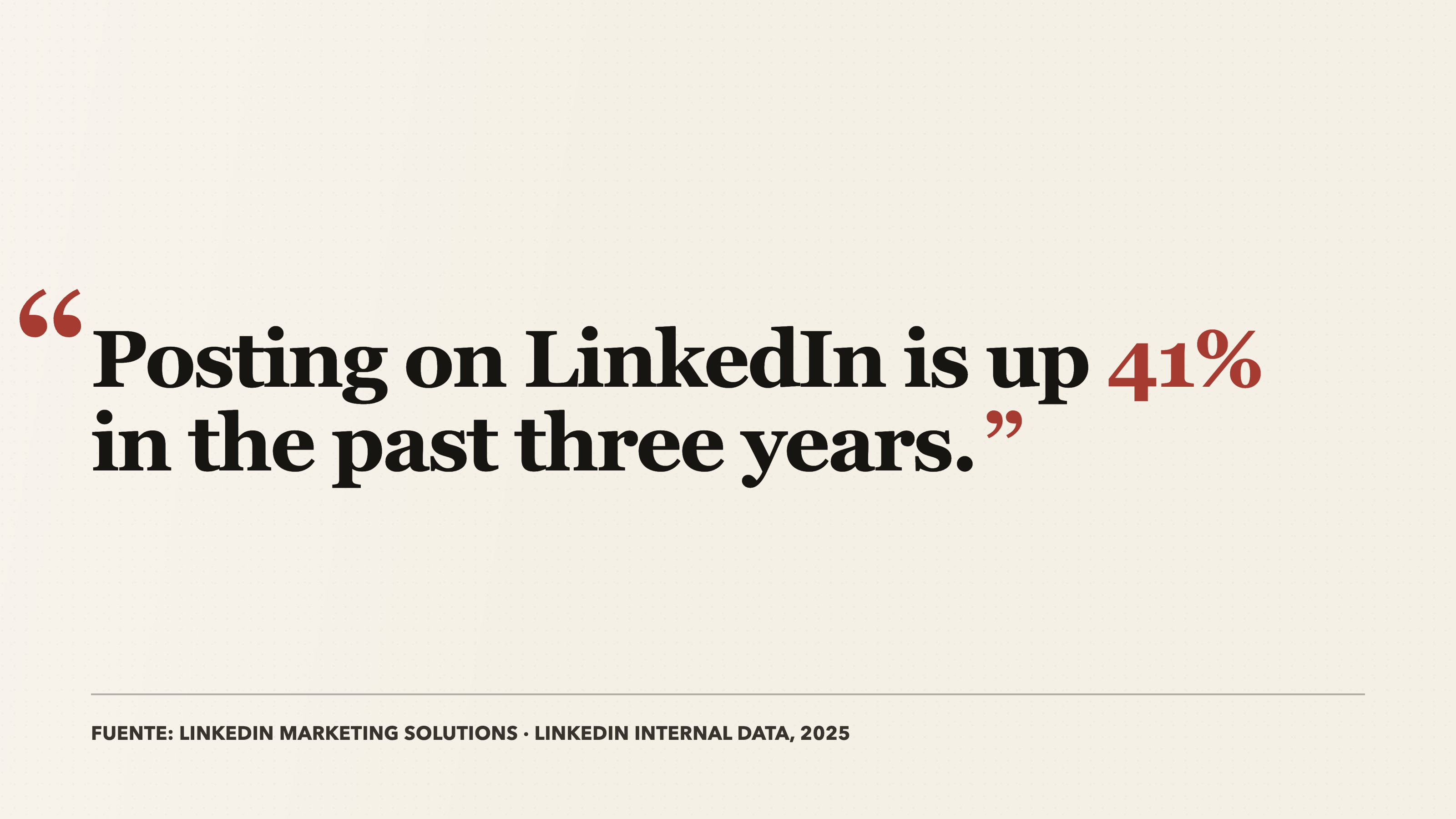
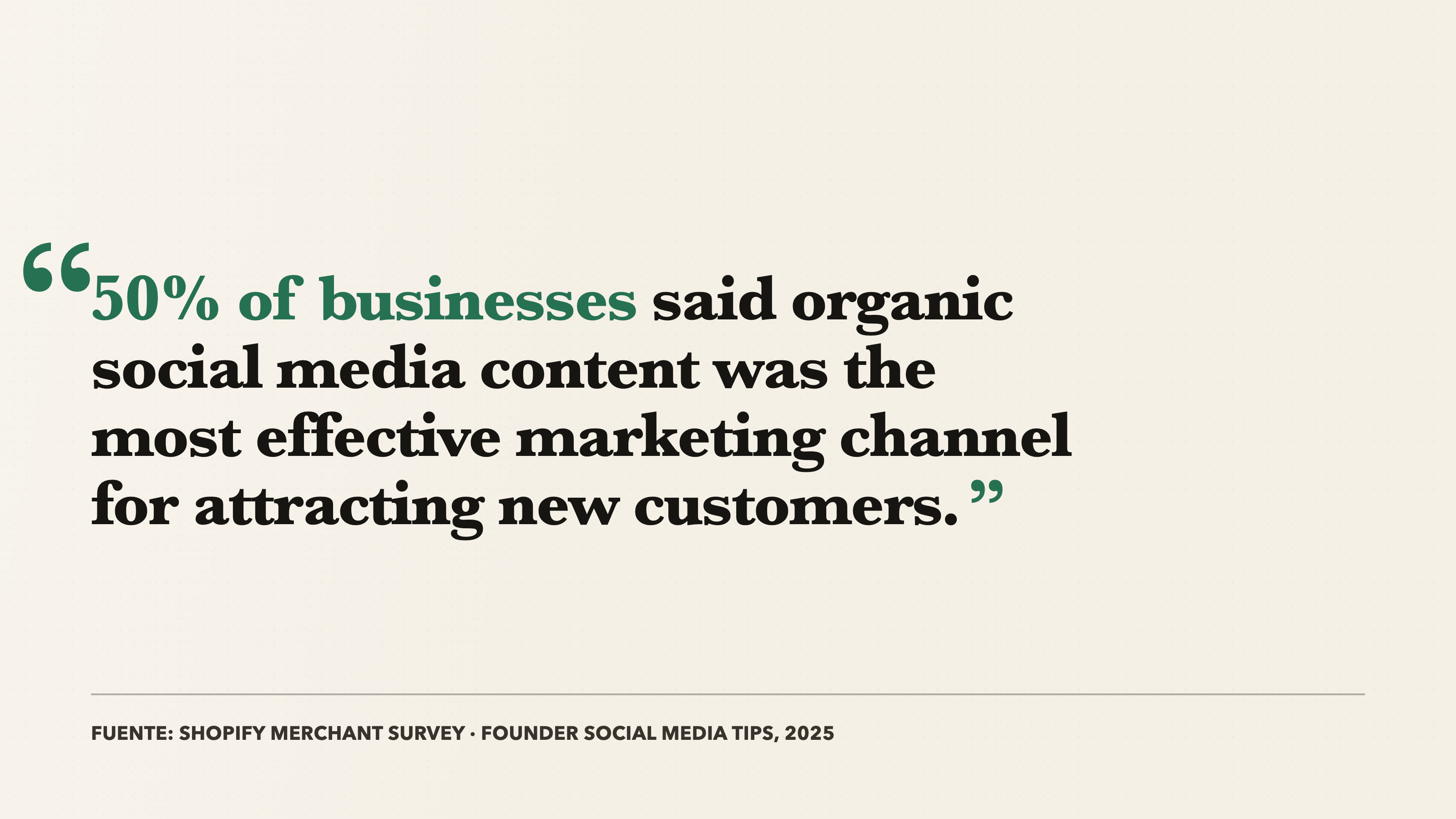
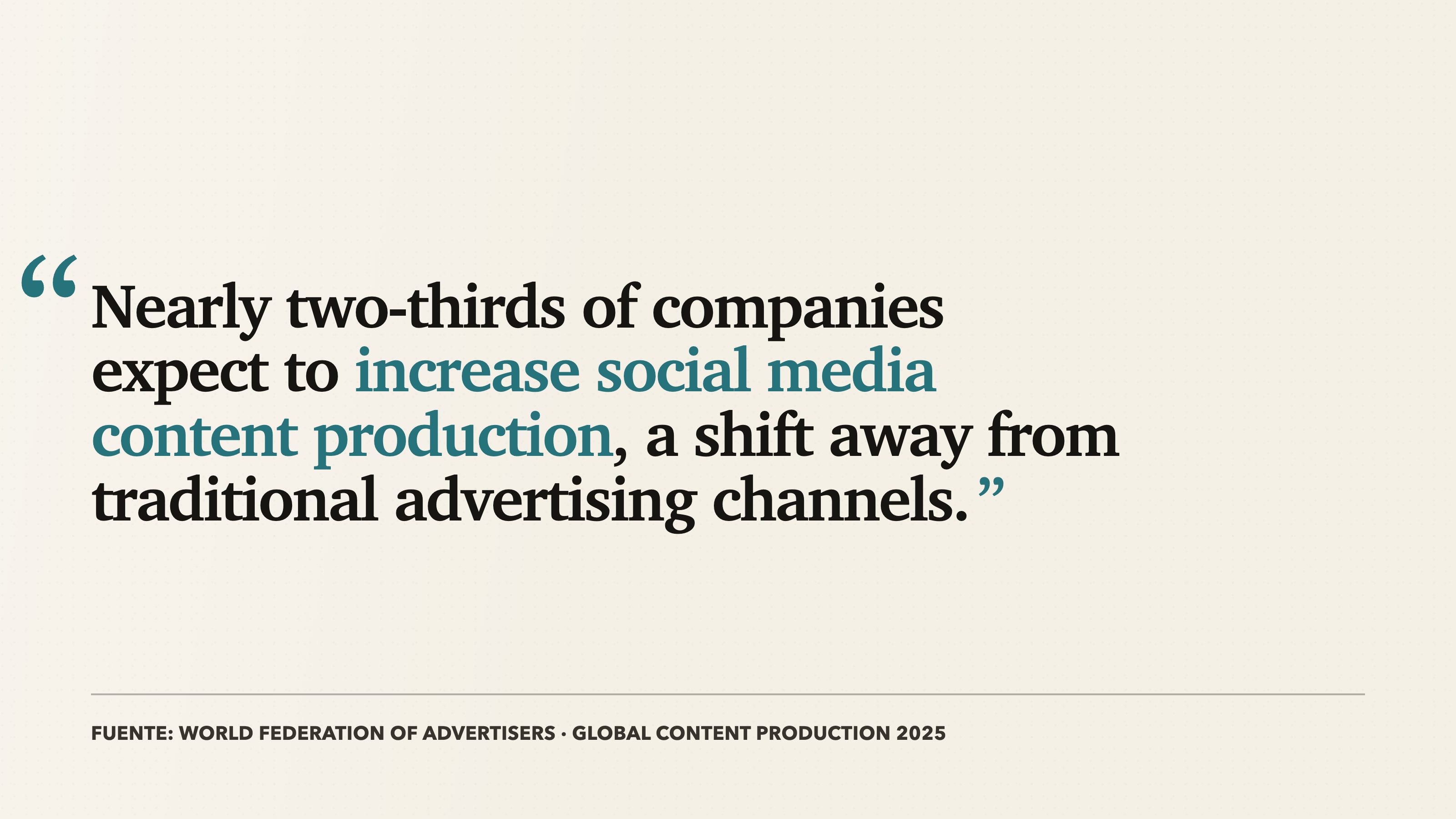
More content means someone has to run it as an operation.
The social media lead (community manager) is the person who coordinates all of that work. In smaller teams they also execute every one of those tasks themselves.
Plans, approvals, creative files, published content, conversations and performance data live across different tools, networks and people. For every new task, the social media lead has to rebuild the brand context and pass it to everyone involved. Each task creates more history, but no system turns it into context for what comes next.




Plan, coordinate, publish, reply and report.
Read posts, transcribe videos and connect content, comments, messages and performance.
Store that knowledge in one shared layer that every feature and agent can use.
The social media lead has to carry the full brand context from one task to the next.
Incumbents built calendars, inboxes, analytics and AI as separate tools, each designed around an isolated task. Moving to shared context means changing the architecture underneath the product and redesigning every workflow so it contributes to and uses the same brand history, without breaking how existing customers already work.
Each agent has to be given context again for every feature and task.
Agents connect once and work from the same brand context as the team.
To become the standard way brands manage social media in the age of AI.
Content management. The calendar, the coordination, the approvals and the performance of every piece.
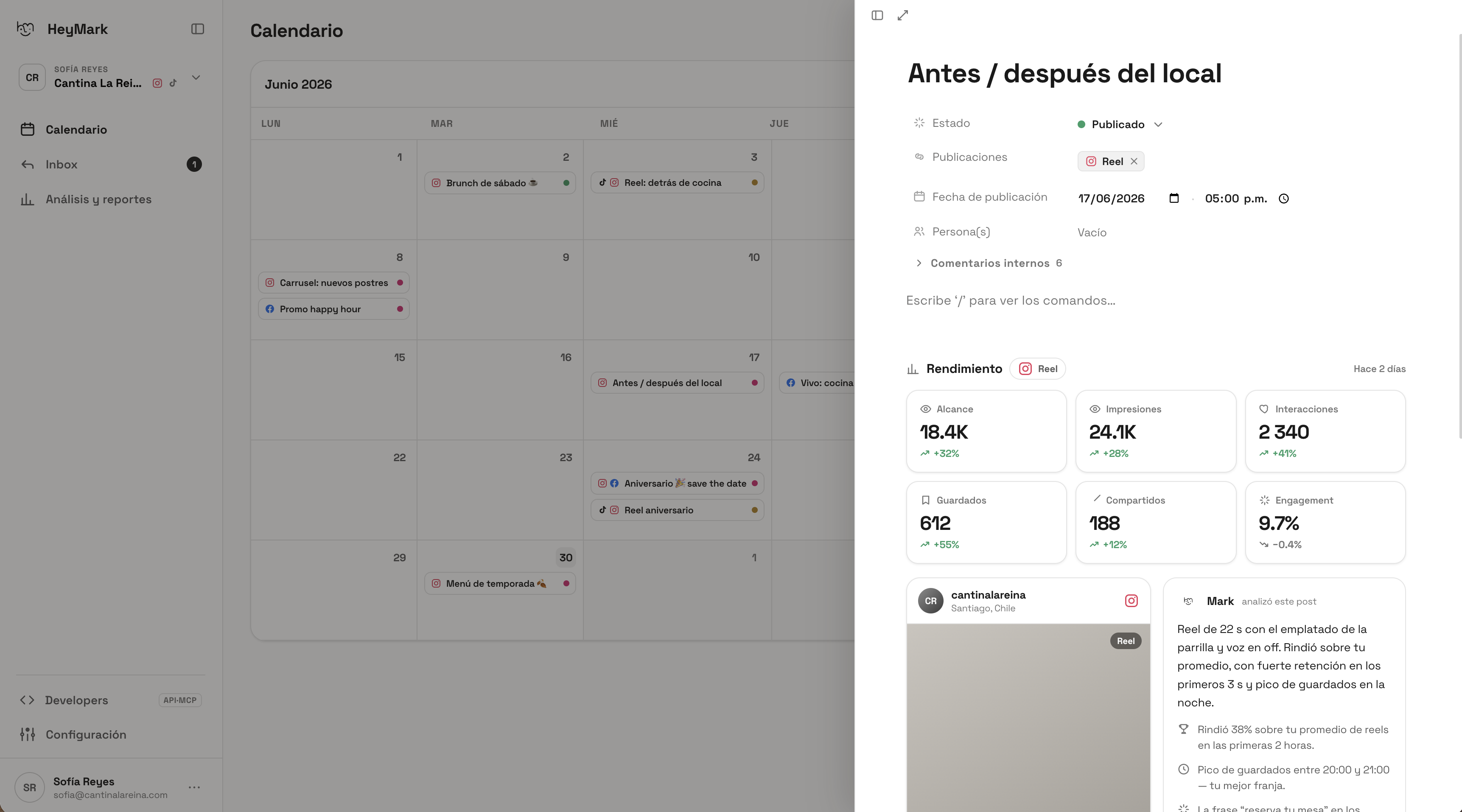
One platform where the social media lead can run the entire content operation. HeyMark keeps the context behind every plan, approval, post, reply and result, then uses it to help with the next task.
Sprinklr FY2026 and Sprout Social FY2025 from SEC filings. Buffer from its live public metrics dashboard. Metricool reported €17M at acquisition by team.blue. Hootsuite is a third-party estimate and is not audited. Postiz and Post Bridge are annualized from the latest month on their public dashboards.
Category size from Fortune Business Insights, all segments and geographies, software and services. The 1.6M base across Spanish-speaking Latin America, Spain and US Latino is built from official company counts and HeyMark serviceability filters. The additional ~3.0M US-general estimate is preliminary. The ~0.04% share is measured against the combined serviceable market, not the category.
$4.9K MRR, 17 customers
Rebuilt around the social media lead
20 social media leads, small cohorts, weekly releases
Four profiles, using usage and willingness-to-pay evidence
Start charging cohort users while we build
Conversion and retention before expansion
The current projection uses $29 Pro and $99 Business subscriptions per brand. The pilot will determine the primary pricing axis and packaging.
Pricing may ultimately combine brands, seats, additional agents and enterprise permissions.
By month 18, assuming 5% monthly churn.
Two conversion paths we will test at launch
Lets every brand experience the core product before choosing a paid plan.
Starts every account with the complete experience, then lets the user decide what to keep.
All of it through organic content distributed on channels we own and created primarily for the Chilean market.
The conversion plan needs around 2,400 signups a month. We have already produced a meaningful part of that through organic content alone.
The new strategy starts with international, bilingual organic content, then tests paid acquisition against CAC and payback targets set by the pilot.



To become the standard way brands manage social media in the age of AI.
HeyMark, 2026
 Linear
Linear entered a paid project management software category estimated at approximately $12B in 2025. Software teams coordinated work across Jira, Asana, documents and chat, while broad, configurable systems fragmented the project history. Before each decision, someone had to reconstruct the context. Linear chose issue tracking as a narrow wedge and rebuilt the workflow around speed and focus.
HeyMark
HeyMark enters a paid social media management software category estimated at approximately $32B in 2025. Brand teams coordinate work across Hootsuite, Sprout, documents, creative tools and chat, while task-specific systems fragment the brand history. Before each task, the social media lead has to reconstruct the context. HeyMark starts with content management and rebuilds the workflow around one shared brand record.
Both are multi-billion-dollar paid categories with the same structural pain: the operator reconstructs fragmented context before moving work forward.
2025 market estimates: project management software $11.91B; social media management $32.48B. Sources: Fortune Business Insights, project management and social media management. Structural precedent, not economic equivalence.
Linear crossed this scale in year seven by entering an existing category with a focused product and expanding into larger teams.
Against a serviceable market of approximately 4.6 million brands, this represents approximately 0.43% of the market.
Twenty thousand paying organizations is a credible scale reference. It does not prove when HeyMark reaches it or how much each organization pays.
Source: Linear at 7. The HeyMark percentage is illustrative because the serviceable market counts brands, while the long-term model counts paying organizations. The ~3.0M US-general estimate is preliminary.
The current model reaches approximately $1M ARR.
Customer scale alone produces a meaningful business.
The missing variable is revenue per organization.
The first step is the month 18 operating plan. The other two are long-term illustrations, not forecasts.
The $44 brand subscription is the wedge. The long-term account includes the portfolio, the people and the workflow around it.
20,000 organizations × $422 × 12 = $101.3M ARR
We do not need to validate $422 today. We need to validate the sequence: retention first, then account expansion.
Change the assumptions and see the monthly acquisition volume required to reach 1,900 paying brands by month 18.
Constant monthly cohorts, same-month conversion and no expansion revenue. Visitor to signup is illustrative until the self-serve funnel is live. Views are not treated as website visitors.
ChartMogul surveyed 200 B2B software products in January 2026. The median product converts 8% of free signups into paying customers within six months. We plan below that median.
Each of these limits the free experience exactly where the user already depends on it. Slack caps message history and integrations, Spotify limits control and adds ads, Duolingo limits pace. For HeyMark the equivalent is the brand context a workspace accumulates while the team works in it.
Published bands for the two mechanics we plan to test: freemium is 3-5% good and 8-12% great, reverse trial is 4-6% good and 8-12% great. Our 6.5% sits inside both, and the previous slide runs the model from 2% to 8%.
ChartMogul, SaaS Conversion Report, January 2026, 200 B2B software products, measured within six months of signup. Spotify: 263M premium subscribers over 675M monthly active users, December 2024. Duolingo: about 9% of monthly active users, 2025 annual report. Slack is a third-party estimate and is not disclosed by the company.
Each profile plans, publishes, coordinates feedback and reviews performance. The paid cohorts will determine where pain, activation and willingness to pay are strongest.
Same core workflow, different buyer, approval path and expansion surface. The pilot selects the beachhead and the primary pricing axis.
Each market starts with its national business census.
Chile example: 409K companies × 63% consumer-facing × 50% active social = approximately 130K active social brands.
Chile provides the reference: 50K serviceable brands divided by 130K active social brands, approximately 38%. The 50K is a central estimate triangulated from three independent signals, each of which shows brands with a managed content operation and proven willingness to spend.
Approximately 600K brands that operate or sell in Spanish or bilingually.
>1.6M serviceable brands across Spanish-speaking Latin America, Spain and US LatinoA preliminary estimate of approximately 3.0M brands in the English-speaking US market.
~4.6M serviceable brands across Spanish and English-speaking marketsThis is an estimated serviceable population, not a census of software buyers. The company counts are official. The operating, social activity and serviceability filters are HeyMark estimates. The ~3.0M US-general estimate is preliminary and has not been reconciled for possible overlap with US Latino.
Professional creators with a monetized brand are counted as brands. They are not added again as a separate population.
Sources: INE and Chile's Ministry of Economy, INEGI, Confecámaras and DANE, INEI, AFIP and SIPA, INE and DIRCE, and US Census ABS and NES-D. Full methodology and bibliography.
Evidence that the category exists and is paid for. We calculate nothing from it.
Our own top-down estimate. Around $225M of it sits in Spanish-speaking markets.
The 1.6M base across Spanish-speaking Latin America, Spain and US Latino, plus a preliminary ~3.0M US-general estimate.
Reaching $1M ARR requires winning existing buyers and turning brands that run social media without a paid tool into new buyers of the category.
1,900 paying brands is approximately 0.04% of the ~4.6M serviceable market across Spanish and English-speaking markets. The ~3.0M US-general component is preliminary.
Category size from Fortune Business Insights. The self-serve slice and the serviceable base are HeyMark estimates. Full methodology and bibliography.
$300K divided by our month-one fixed burn of $18,750. It assumes we never sell anything.
Cash-flow positive, four months before the $1M ARR milestone at month 18.
Minimum cash, reached in month 13. It climbs from there.
Both numbers run on the same clock. Month 1 is August 2026, month 14 is September 2027 and month 18 is January 2028.
The 16 months are a floor calculated at month-one burn with no revenue. The plan reaches breakeven before that floor is ever tested.
Enough to reach breakeven and prove the acquisition engine.
Net cash burned before the plan turns cash-flow positive.
Cash at the lowest point, in month 13, before it climbs.
Operating spend through month 13 is $364,597. Revenue covers $161,452 of it, so the round funds the bridge to breakeven rather than the whole operation.
The reserve is unallocated on purpose. It covers what a first launch always needs and cannot be scheduled in advance: extra engineering for a new network integration, design and content help at launch, onboarding support for the first paid cohorts, or AI compute if usage spikes. The model gives it no revenue uplift, which keeps the plan conservative.
No sales team, no enterprise build and no office expansion. Paid growth and the reserve are gated at month 7 and can be cut without touching the product. Founders are three at $3,000 a month, dropping to $1,000 at that gate. Figures are the base case, cumulative from month 1 to month 13.
Month reaching $1M ARR run-rate, with the cash position behind each case.
Cash-flow positive after month 24. Minimum cash $52K, protected by a month-7 gate that cuts paid acquisition, trial spend, every hire that has not started and founder salaries.
Cash-flow positive at month 14. Minimum cash $97K.
Cash-flow positive at month 10. Minimum cash $205K.
The pilot will replace the model's key assumptions with measured inputs before we scale acquisition and hiring.
Each scenario moves conversion, growth, activation and churn together. All three end month 24 with cash in the bank.
The closed beta started last week with limited access. More than 200 people requested a spot organically, while the first cohort progressed through the complete setup flow.
Demand generated through HeyMark's Instagram before opening access broadly.
Early activity is concentrated in the product's core workflows and in Mark, the product agent.
One motion lives inside the product, one earns the AI recommendation, one reaches the community manager directly. All three are measured by attributed signups, not reach.
Click each motion to see how it works
The approval link and monthly report the CM shares carry HeyMark. A clean one signals a serious operator, so it gets shared by default, and the person who opens it is the one who approves the spend. Whether sharing is free or inside a paid plan is the same freemium versus reverse trial lever the pilot decides. The one motion that compounds on its own.
We publish where the models read. Humans interact with it there, and that engagement is what makes the model treat us as the answer it gives the community manager.
The media we use, and what each is for
Real user consensus and high-intent questions.
The shortlist models read for "alternatives" queries.
Demos and tutorials the models surface.
Professional and real-time discussion, entity authority.
Our own source of record, and where signup happens.
We reach the CM at every media touchpoint they already have. The creators and educators they follow, in their communities on Slack, Discord and Skool, use HeyMark and show the work built with it. And we distribute directly on Instagram, TikTok and YouTube in two lines: product accounts under heymark.ai, and building in public under heymark.tv.
We reach the community manager from every angle: when they learn in their communities and channels, when they scroll their feed, and when they ask for a content management solution.