
HeyMark
Social media management, rebuilt for the age of AI.
Plan what comes next, publish everywhere, and understand what works for your brand.
Driven VC, July 2026
Earning attention turned into an internal operation
Every company that wants to grow has to earn attention, and increasingly that happens through the content it publishes on social. Social media stopped being the place where you run occasional campaigns. It became an operating channel.
Posting on LinkedIn is up 41% in the past three years.
There are over 20 million videos uploaded daily to YouTube.
Both views and time spent watching original Reels on Facebook approximately doubled in the second half of 2025.
Who runs that operation
The community manager is the person who coordinates all of that work. In smaller teams they also execute every one of those tasks themselves.
HeyMark is where that operation runs
HeyMark
One place where the work, the people and the decisions around every piece of content live together.
Our big ambition
To become the standard way brands manage social media in the age of AI.
And where we begin
Content management. The calendar, the coordination, the approvals and the performance of every piece.
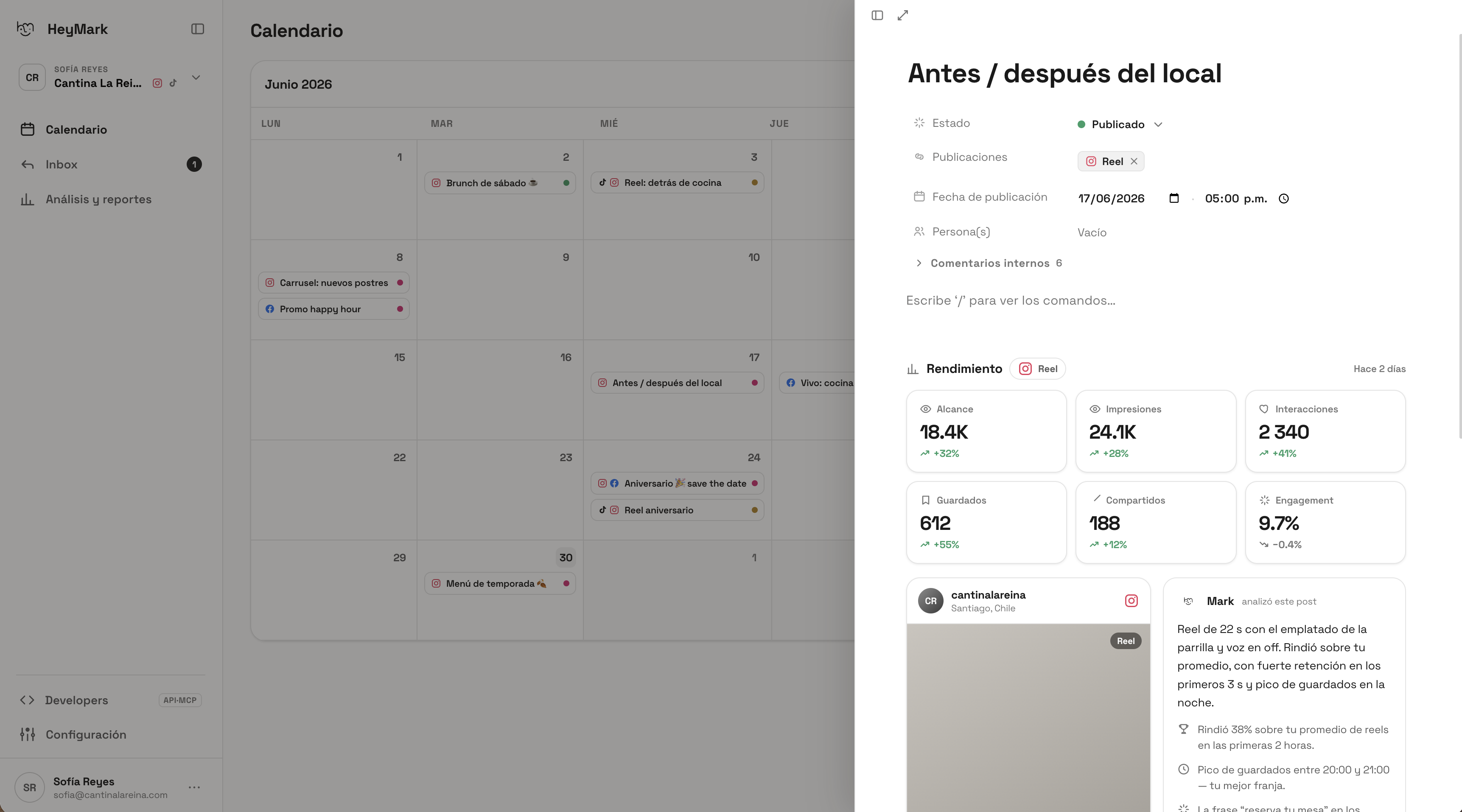
This is what that starting point looks like today
One piece of content carries the visual, the approvals, the iterations, the reasoning behind each decision, and the numbers it produced. It is the densest object in the entire workflow. That is why we start there.
These platforms already exist. So why is the job still broken?
They are adding AI to a workflow built for a different era.
This is not a category we need to invent
Willingness to pay for social media management is already proven, from individual operators to the largest enterprises in the world.
Sprinklr FY2026 and Sprout Social FY2025 from SEC filings. Buffer from its live public metrics dashboard. Metricool as disclosed by team.blue at acquisition. Hootsuite is a third-party estimate and is not audited. Category size and growth from Fortune Business Insights, $32.5B in 2025 to $164.5B in 2034, CAGR 19.7%.
The shift is already visible
Postiz is an open-source scheduler built in public by a single founder. It went from $18K to $152K of monthly revenue between January and June 2026. The inflection lines up with the moment it started selling to AI agents rather than only to people.
Publishing infrastructure alone is not the whole opportunity. But it is clear evidence that customers adopt a new product in this category when it reflects how the work is changing.
A proven category is being rebuilt right now.
We narrowed the problem by building it
From February to June 2026 we built and sold an AI agent that tried to run a company's entire marketing operation: ideas, scripts, images, video, social publishing, paid media, email and comment automation.
Every feature we shipped competed against a product dedicated to only that. Covering all of marketing left us good at everything and exceptional at nothing.
Users arrived expecting to automate all of their content. It is possible, but the output is weak: it removes the human from the part where they add the most value, the creative one.
To keep the human in the creative loop we put our own people on ideation and editing. Scaling that meant becoming an AI-enabled agency, not a product.
Creation belongs to humans. What a tool can do exceptionally well is help them manage the work around it.
One job. Three operating environments.
The same community manager role runs in three different contexts. The scale and the coordination burden change. The core job does not.
Works inside a company, running its own brand. Early on this is often the founder or whoever leads marketing.
Works independently, running social for several client brands at once.
Works inside an agency, handling multiple client accounts in parallel.
The operator is the community manager, but the person approving the spend is often their counterpart: the brand owner, the marketing lead or the agency. That is why we charge per brand, one workspace per brand, not per seat.
We have not yet decided which of these is our first narrow wedge. The pilot picks it with evidence, comparing pain, activation, time to value, retention and willingness to pay.
Start with one community manager. Earn the right to expand.
Chile is where we run paid acquisition first, because feedback and CAC are cheap there. The product is bilingual and self-serve, so organic distribution starts internationally from launch. Chile is the laboratory, not the limit.
Bottom-up model built from official company counts, filtered by active social operation and ability to pay. The serviceable base is an estimate.
A simple starting model
Self-serve first. The billing unit is the brand.
One workspace per brand. Creators and small businesses.
More capacity for teams and agencies with a heavier operation.
Expands each workspace without changing the per-brand economics.
Paid plans leave a 64% to 80% margin. Today the product runs a 7-day free trial with a card on file, behind a hard paywall, which is what the closed beta uses.
Still open, and deliberately so: the public launch mechanic. Freemium and reverse trial are live options once there is cash to build and operate a free tier. The expansion axis, whether it runs on brands, networks or seats, is the other open question.
Build for the daily user. Let the organization follow.
Designing for the community manager is also what makes the distribution work. One person can start with one brand and get value without an implementation project or an organizational rollout.
Two lines, product and brand vision. The main engine.
The founders already publish and have organic distribution.
Every analysis becomes an insight or report the CM can share with whoever approves the spend.
Where we can validate the engine at the lowest CAC before scaling it elsewhere.
Adoption starts with individual usefulness and can grow into organizational value. A higher-touch offer for large companies can come later. The opening motion is self-serve.
The metrics that will decide the model
We are not presenting assumptions as results. These are the signals we are instrumenting, and what each one decides.
Activation, the share who connect an account and reach the verdict. Time to value. Whether the analysis resonates. Willingness to pay.
Retention at D1, D3 and D7. Whether they use the approval loop or invite the client or team. Publishing reliability with zero silent failures.
Conversion, CAC and payback by channel, gross margin at real usage mix, and net revenue retention.
A team that has already built, sold and operated

We are six. We want that number to be surprisingly low. We are raising to accelerate, not to survive.
$300K to prove the repeatable system
We are raising US$300K on a post-money SAFE with a $3M cap.
Next round: seed at $1M ARR, which the plan reaches around month 18 with roughly 1,900 paying brands.
Thank you
To become the standard way brands manage social media in the age of AI.
HeyMark, Driven VC 2026